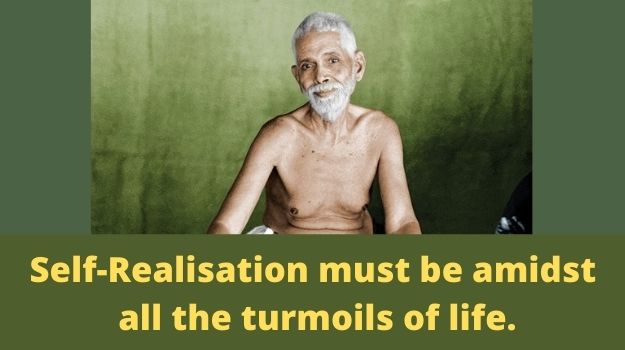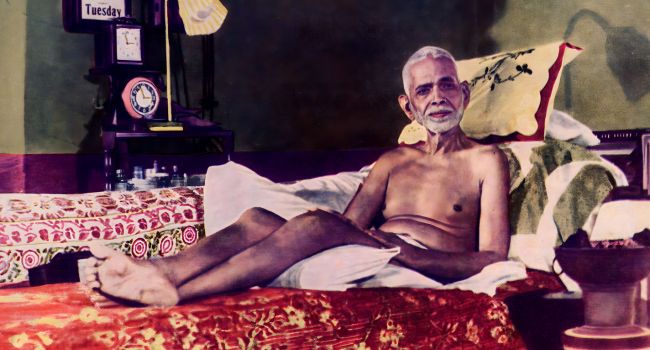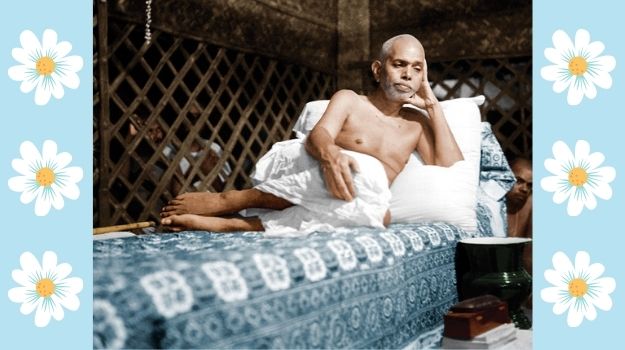
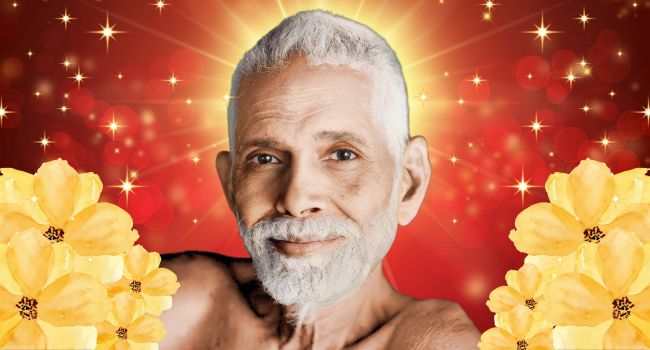
The following excerpt has been taken from the life sketch of Sri Ramana, in the introductory chapter of the book, Face to Face with Sri Ramana Maharshi.
Sometime in the middle of July 1896, when he was just sixteen and a half years old, Venkataraman (boyhood name of Maharshi Ramana) realised the Self in a miraculous manner. Years later, he described the event himself in the following words:
About six weeks before I left Madurai for good, a great change took place in my life. It was quite sudden. I was sitting alone in a room in my uncle’s house, when a sudden fear of death overtook me. There was nothing in my state of health to account for it. I just felt, ‘I am going to die’ and began thinking about it.
The fear of death drove my mind inwards and I said to myself mentally, ‘Now that death has come; what does it mean? What is it that is dying? Only this body dies.’
And at once I dramatised the occurrence of death. I held my breath and kept my lips tightly closed and said to myself, ‘This body is dead. It will be carried to the cremation ground and reduced to ashes. But with the death of this body am I dead? Is this body ‘I’? I am the spirit transcending the body. That means I am the deathless atman (soul).’
What happened next is difficult to comprehend, though easy to describe. Venkataraman (Maharshi Ramana) seemed to fall into a profound conscious trance wherein he became merged into the very source of selfhood, the very essence of Being. He quite clearly perceived and imbibed the truth that the body was a thing apart from the atman that remained untouched by death.
Venkataraman emerged from this amazing experience an utterly changed person. He lost interest in studies, sports, friends and so on. His chief interest now centered in the sublime consciousness of the true Self, which he had found so unexpectedly. He enjoyed an inward serenity and a spiritual strength, which never left him.
The new mode of consciousness transformed Venkataraman’s sense of values and his habits. Things he esteemed earlier had now lost their appeal. In his words: “Another change that came over me was that I no longer had any likes or dislikes with regard to food. Whatever was given to me, tasty or insipid, I would swallow with total indifference.”