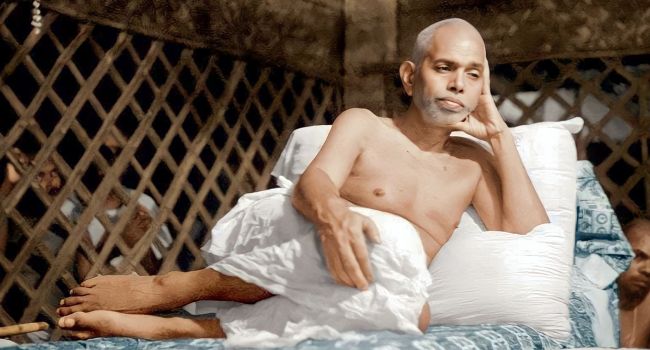
The enclosed incident has been narrated by V Ganesan in his book: The Human Gospel of Ramana Maharshi.
Bhagavan Maharshi Ramana fulfilled his duties to his mother. He was already well known, with many people beginning to serve him. They would fetch water for him and painstakingly carry it uphill. However, for his own mother‘s needs, Bhagavan would bring water himself.
He would carry two big kamandalus, make her sit and then, he would pour water over her to bathe her. He would also wash her clothes. While he attended to her physical requirements and was affectionate with her, she matured spiritually.
Over eight years, slowly but surely, she was weaned away from the limiting confines of narrow-mindedness, dogma, orthodoxy, superstition, myths and social customs. The beauty of their relationship is that Bhagavan‘s mother surrendered to it all and allowed the transformation to take place.
Eventually, Bhagavan’s mother fell seriously ill. Early in the morning, on the day of her death, Bhagavan sat next to her and put his left hand on her head and his right hand on the right side of her chest. He remained like that for nearly eight hours.
The devotees who had gathered there knew that her end had come. They observed the beauty and the sanctity of the son relinquishing the mother to the infinite.
Kunju Swami and others, who were present, later said that they felt that it was a physical demonstration to his devotees of one’s Self becoming seamless with the Absolute; the Darshan was like the heat and light spreading from a flame. After eight hours, Bhagavan removed his hands.
Previously with another devotee, Palani Swami, Bhagavan had done the same thing, but at the last moment when he took his hands off, the life force vanished. This time, he remained with his hands placed on her until he felt a tingling sensation.
Bhagavan said, “When the one merges with the Self and is completely annihilated, a soft clang, like that of a bell, can be felt.” It was a common practice that after witnessing a death, all those present must bathe.
However Bhagavan said that in this case there was no need to, as there was no pollution. “She did not die. Instead, she is now absorbed in Arunachala, the Self”, he stated.
Later the devotees who were present enquired, “Bhagavan, what did you do by keeping your hands on her head and her chest? What exactly took place?”
Bhagavan explained, “Innate tendencies and subtle memories of past experiences that lead to future possibilities became very active when my hands were placed on her. Scene after scene rolled before her in subtle consciousness.
The outer senses had already gone. The being was at last disrobed of all the sheaths and limitations as it seamlessly joined the ocean, the supreme peace of liberation, from which there is no return to ignorance.”
What is the precept that Bhagavan lay down before us through his mother’s example? When Bhagavan was asked what the essence of his teaching was, he would reply, “Either ask, ‘Who am I?’ or surrender. They both are two sides of the same coin.”
Bhagavan clearly demonstrated the nuances of ‘Who am I’ in the lives of many devotees. However, with the example of his mother, he taught the aspect of surrender – for his mother had surrendered completely.