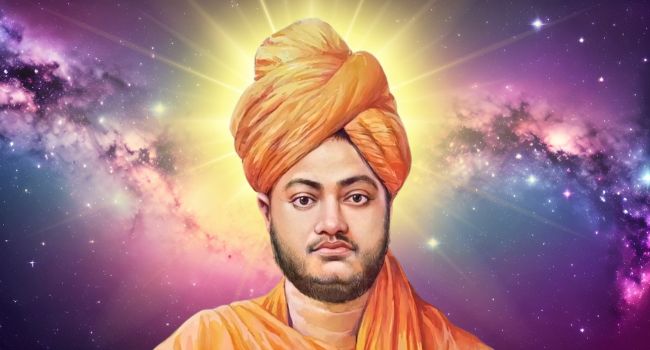
Swami Vivekananda: It is in the Aryan literature that we find women in ancient times taking the same share as men, and in no other literature of the world.
Going back to our Vedas – they are the oldest literature the world possesses and are composed by your and my common ancestors. Their oldest portion is composed of hymns, and these hymns are to the gods whom the Aryans worshipped.
I may be pardoned for using the word gods; the literal translation is “the bright ones”. These hymns are dedicated to Fire, to the Sun, to Varuna and other deities. The titles run: “such-and-such a sage composed this verse, dedicated to such-and-such a deity”.
In the tenth chapter comes a peculiar hymn – for the sage is a woman – and it is dedicated to the one God who is at the background of all these gods. All the previous hymns are spoken in the third person, as if someone were addressing the deities.
But this hymn takes a departure: God (as the Devi) is speaking for herself. The pronoun used is “I”. “I am the Empress of the Universe, the Fulfiller of all prayers.” (Vide “Devi Sukta”, Rig-Veda 10.125)
This is the first glimpse of women’s work in the Vedas. As we go on, we find them taking a greater share – even officiating as priests. There is not one passage throughout the whole mass of literature of the Vedas which can be construed even indirectly as signifying that woman could never be a priest. In fact, there are many examples of women officiating as priests.
Then we come to the last portion of these Vedas (the Upanishads) – which is really the religion of India – the concentrated wisdom of which has not been surpassed even in this century. There, too, we find women preeminent.
A large portion of these books are words which have proceeded from the mouths of women. It is there – recorded with their names and teachings. There is that beautiful story of the great sage Yajnavalkya, the one who visited the kingdom of the great king Janaka.
And there in that assembly of the learned, people came to ask him questions. One man asked him, “How am I to perform this sacrifice?” Another asked him, “How am I to perform the other sacrifice?”
And after he had answered them, there arose a woman who said, “These are childish questions. Now, have a care: I take these two arrows, my two questions. Answer them if you can, and we will then call you a sage. The first is: What is the soul? The second is: What is God?” (Brihadaranyaka Upanishad 3.8.1 to 3.8.12)
Thus arose in India the great questions about the soul and God, and these came from the mouth of a woman. The sage had to pass an examination before her, and he passed well.
Source: Complete Works of Swami Vivekananda, Volume 9 – Lecture: The Women of India